
Blockbuster year for global equity markets

Blockbuster year for global equity markets

Market Commentary Q4 2025
SMM_FF_Spring

Global equity markets ended 2025 on a strong note, having notched up double-digit returns in a turbulent year that was dominated by tariff wars, AI mania and simmering geopolitical tensions.

President Trump’s hardline tariff agenda became one of the most consequential stories of the year and few predicted the end results or how wild the ride would get. The plan was to put ‘America First’ and aimed at reviving a declining manufacturing base. The increased tariffs lifted the average rate to nearly 17% from less than 3% at the end of 2024, according to Yale University’s Budget Lab, and are now generating revenue of roughly $30 billion a month for the US Treasury. They brought world leaders scrambling to Washington seeking trade deals for lower rates, often in return for pledges of billions of dollars in US investments.
 

Trade deals were reached with a host of major trading partners but notably, a final agreement with China — the world’s second largest economy — remains on the incomplete list despite multiple rounds of meetings and a face-to-face meeting between President Trump and Xi Jinping. China used the leverage it has gained in rare earth minerals — crucial inputs into the West’s security scaffolding — to push back against pressure from the US to increase more tariffs. US Treasury Secretary Scott Bessent described China’s actions as “pointing a bazooka at the supply chains of the Western world.”
Risk-on sentiment drove an ‘everything rally’

The day after tariffs were announced on 2 April, major stock indices shed around $3.1 trillion in value. The sell-off amounted to the biggest one-day decline since the onset of the Covid-19 pandemic. Trump backed off on some of his tariffs on 9 April, triggering euphoria among investors after he announced a 90-day pause on the reciprocal tariffs for ‘non-retaliating’ countries. Yet through that turbulence, markets adapted. Resilience emerged with most global equity markets closing out the year at near all-time highs.

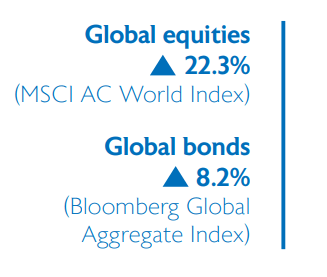
The MSCI AC World Index ($) climbed 22.3%, reflecting widespread growth across developed and emerging markets. The ‘anywhere but America’ (ABA) trade was one of the best calls of the year as lower valuations outside the US, less concentration risk and a weaker dollar meant equity markets in the UK, Europe, Japan and emerging markets all beat both the S&P 500 Index and the Nasdaq. The MSCI EM Index was up 34% in dollar terms. ABA trade is a sharp reversal from the past decade when strong returns from US shares gave rise to a new investment thesis: ‘American exceptionalism’ — the belief that strong economic growth, healthy profit margins and cutting-edge tech behemoths make America’s share market the best place on earth for investors to invest their savings.

The rally in risk assets extended to the bond market. With central banks lowering interest rates and currency tailwinds — dollar weakness — the Bloomberg Global Aggregate Global Bond Index returned 8.2% in dollar terms in 2025.

Fed continued to cut rates

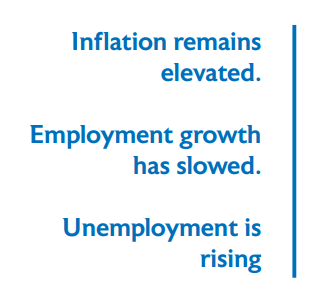
The Fed cut interest rates three times in 2025. At its last meeting in December, they lowered the benchmark interest rate to a range of between 3.5% to 3.75%, as officials agreed that a slowdown in monthly employment and rising unemployment warranted slightly less restrictive monetary policy. But new projections show only one rate cut is expected this year and any further cuts are likely to be kept on hold for now until new data shows that either inflation is falling or unemployment is rising more than anticipated.

The artificial intelligence boom maintained momentum

By January, concern over the health of the economy and skepticism about the US’s lead in the AI race, began to creep into investor sentiment. This after Chinese tech upstart DeepSeek unveiled an AI chatbot that raised concerns about Silicon Valley pouring unnecessary amounts of money into artificial intelligence (AI) companies. President Trump’s trade fights, together with news later in the year of souring corporate loans and the longest US government shutdown in history, heightened anxieties. 

Despite all the uncertainties, the market continued to ‘climb a wall of worry’ as risk assets maintained their upward trajectory. AI remained the dominant theme driving US equity markets. The S&P 500 Index was up 17.8%, while the Nasdaq Composite gained 21%. AI trade broadened out last year as chip shares again led the S&P 500 but were joined by the shares of companies tied to building the data centers that will power the technology. Three of the index’s top 10 performers in 2025 were data storage companies, which are among the main beneficiaries of the hundreds of billions of dollars in pledged spending by the giant AI cloud service providers known as hyperscalers. On the flip side, consumer-facing sectors struggled as sluggish employment growth weighed on consumer confidence. Concerns about softening demand meant that companies were nervous about passing on tariff costs. Health care shares struggled with uncertainty surrounding the administration’s policies and pressure on drug prices.

Profit growth to remain strong

Analysts expect corporate profit growth to accelerate next year, driven by a resilient US economy, supportive policy, and AI spending. The S&P 500 is expected to grow earnings 15% this year, up from a little over 12% last year and well above the 10-year average of 8.6%, according to FactSet Research. Overall, the forward P/E ratio is 22 times – relatively expensive versus the 30-year average of only 17.1 times, according to JP Morgan Asset Management.

AI bubble or not?

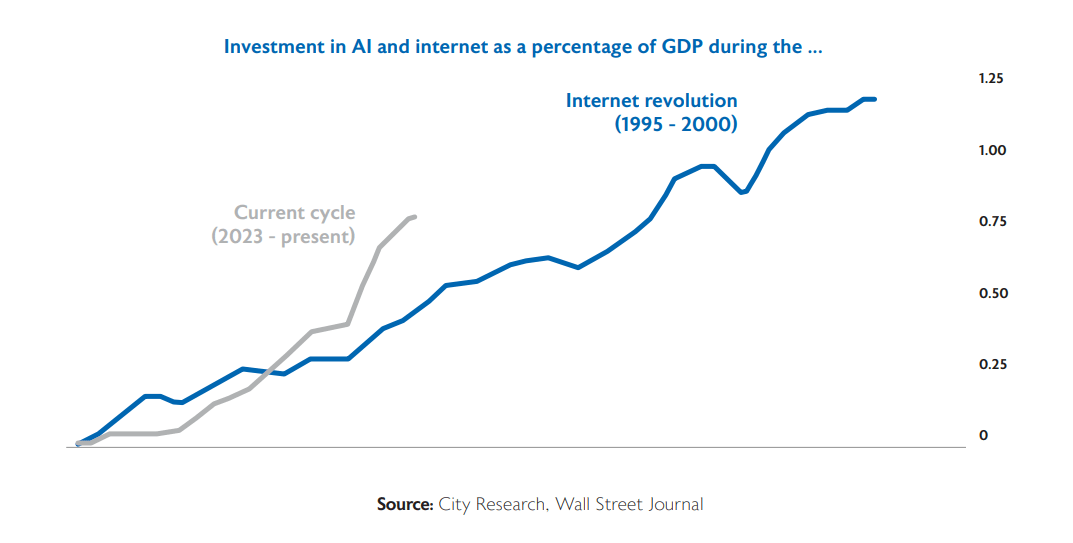
For almost as long as the AI boom has been in full swing, there have been warnings of a speculative bubble that could rival the dot-com craze of the late 1990s that ended in a spectacular crash and a wave of bankruptcies. Cisco Systems, the dotcom-era champion that became the world’s most valuable company at its peak in March 2000, only reached that same share price level again in December 2025. It is a cautionary tale of how far share prices can depart from reality, as can be seen below.

Just as the dot-coms were priced based on hope that the internet would deliver a new era of profits from business models that were yet to be proven, so it is with AI. Generative AI has delivered chatbots and image generation that seem to be not far from magic but is, for now, priced well below what it costs to produce, leading to big losses at AI businesses. The internet was built on a global network of fiber-optic cables laid by telecom companies, leading to heavy corporate spending financed by debt. The large language models behind advanced AI are built on giant data centers, leading to heavy corporate investment increasingly financed by debt, as well as by Big Tech’s cash from its legacy businesses. The numbers in 2000 were immense, with well over $100 billion being sunk into new telecom networks in the late 1990s. There was so much fiber that much of it ended up moth-balled for a decade before internet traffic expanded enough to justify using it. The race to build data centers is even more extreme, with investment figures in the trillions thrown around by leading AI developers. Spending is so large that economists say it is making up a significant share of gross domestic product growth. Citi Research illustrates the investment in AI as a percentage of GDP in the current cycle versus that of the internet revolution. AI investment is clearly growing at a faster rate. 

Large tech companies are relying increasingly on debt to support their unprecedented spending. According to a report released in September by Bain & Co., by 2030 AI companies will need $2 trillion in combined annual revenue to fund the computing power needed to meet projected demand. However, Bain predicts their revenue is likely to fall $800 billion short of that mark. 

Like the dot-com era, a few high-flying companies will almost certainly go bust. The bursting of the dot-com bubble helped cause the 2001 recession and led the Nasdaq to lose more than 75% of its value by late 2002. But there will also be large businesses that emerge and thrive over the long term, just as happened with Amazon.com Inc. and Alphabet Inc.’s Google in the late 1990s. 

There are also some key differences to the dot-com boom that market watchers point out, such as the broad health and stability of the biggest businesses that are at the forefront of the trend. Most of the ‘Magnificent Seven’ group of US tech companies are long-established giants that make up much of the earnings growth in the S&P 500 Index. These firms have huge revenue streams and are sitting on large stockpiles of cash. 

Despite the scepticism, AI adoption has also proceeded at a rapid clip. OpenAI’s ChatGPT has more than 800 million weekly users, making it one of the fastest growing consumer products in history. While the company does not expect to be cash-flow positive until near the end of this decade, an October deal to help employees sell shares gave it an implied valuation of $500 billion, making it the world’s most valuable company never to have turned a profit.

China

The Shanghai Composite Index gained 18% in local currency, its best showing since 2019, after reaching its highest closing level in a decade in August. Technology shares have been standout performers since the so-called “DeepSeek moment” in January, when a domestic startup unveiled a large language model viewed as a challenger to OpenAI’s ChatGPT. The surge in AI-related activity also helped Hong Kong reclaim the top spot globally for IPO fundraising for the first time since 2019, according to a report by KPMG. These factors helped offset concerns over sluggish domestic demand and persistent deflation pressures. Authorities signalled that they would continue to take a measured approach to stimulus with a focus on managing overcapacity and addressing the ‘disorderly competition’ among businesses that is adding to the deflationary trend. 


Beijing has since elevated technological self-sufficiency as a key priority in its next five-year plan.

Europe: the door is closed to more interest rate cuts

The European Central Bank (ECB) kept policy rates steady at its last meeting in December and revised its growth and inflation projections upwards, a move that probably closes the door to further cuts in borrowing costs in the near term. Recent growth figures for the Eurozone have beaten the ECB’s expectations, buoyed by consumer spending and exporters navigating US tariffs more effectively than anticipated. The ECB expects growth of 1.4% for 2025 and 1.2% in 2026. Inflation has been hovering close to the ECB’s 2% target – 2.1% by November – suggesting price pressures remain moderate.

European equities delivered their best return since 2021

The STOXX 600 Index was up 16% in local currency last year, driven by lower interest rates, Germany’s fiscal support and rotation away from ‘expensive’ US tech shares. The weaker dollar and White House ‘volatility’ also led investors to seek value elsewhere and diversify against AI risks, benefitting European markets through cautious rebalancing. The equity market was propelled by stellar gains for banks (up 67%) and defence shares (up 56%). The defence sector has scored by pledges of higher defence spending across Europe, with Germany expected to spend up to a trillion euro on defense and infrastructure.

UK: equity market recorded its best year in more than a decade

After years of underperformance, Britain’s blue chip FTSE 100 Index outpaced major global markets in 2025, lifted by expectations of further Bank of England (BoE) rate cuts and its appeal as a relatively cheap diversifier during bouts of global volatility. 


The index rose 22% in local currency for the year, its fifth straight annual gain. In December, the BoE delivered its fourth 25 basis point cut of the year in a narrow vote, while signalling the already gradual pace of easing may slow further. After a sharp drop in inflation, down to 3.2% in November, and a new forecast from the BoE that growth will stagnate in late 2025, the key interest rate was lowered to 3.75% from 4.0%.

Japan: global bright spot in 2025

Contrary to other developed markets, Japan is firmly in a reflation phase with growth, wages and prices all in an upcycle. This allowed the Bank of Japan to raise interest rates to their highest level in three decades, from 0.5% to 0.75% in December. The Nikkei 225 Index jumped 26% in local currency. A US/Japan trade deal, which lowered US tariffs on almost all Japanese exports from 25.0% to 15.0%, combined with corporate governance reforms and pro-growth agenda from new prime minister Sanae Takaichi, contributed to the strong equity performance

SA: improved optimism and a strong market rally

The SARB revised its GDP growth for 2025 higher, albeit modestly, from 1.2% to 1.3%. Several positive developments — a credit rating upgrade, the exit from the FATF greylist, and the SARB’s firm inflation targeting stance — are contributing to a more stable financial environment and supporting economic activity. While challenges such as high unemployment and the need for continued infrastructure investment remain, the overall outlook is one of guarded optimism. For example, in December the local bond market raised R11.8 billion in SA’s first infrastructure bond sale, drawing bids for more than twice the amount sought and boosting construction-led growth plans.

Gold shares stole the show

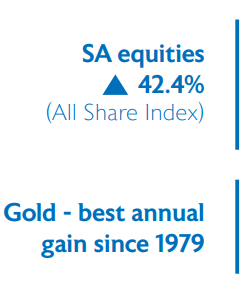
The FTSE/JSE All Share Index gained 42% in 2025, driven largely by an extraordinary run in the mining sector – resources were up 126%, benefitting from a commodity price windfall. Gold, silver and platinum jumped to all-time highs to extend a historic end-of-year rally for precious metals.

Safe-haven gold gained 65% last year, driven by multiple factors, including geopolitical and economic uncertainties, expectations of US rate cuts, strong central bank buying, the ‘de-dollarisation’ trend and robust exchange-traded fund inflows. There were massive returns from gold companies — Gold Fields (up 200%), AngloGold (up 242%), Harmony (up 124%), Sibanye (up 313%) and Implats (up 204%).
But this hid deep losses in the retail sector amid a subdued economy and fewer interest rates cuts than some were expecting. Consumer spending was restricted by a continued surge in online gambling, re-emphasizing the ongoing need for investor education. While Pick ‘n Pay (-19%), Shoprite (-9%) and Woolworths (-9%) all lost ground, others were hit even harder last year. Foschini lost 50%, together with Truworths (-45%), Spar (-35%) and Mr Price (-41%). Mr Price’s announcement in December to buy Germany-based retailer NKD wiped R9 billion off its market value after the share price plunged on the news — the retail sector has a history of missteps in international expansion efforts. 


The rally in risk assets extended beyond the equity market. The All Property Index was up 30.5% — when faced with the headwinds of the pandemic and prolonged load shedding, the industry did not sit back and wait for conditions to improve. Management teams actively strengthened balance sheets and stabilised portfolios. Loan-to-value (LTV) ratios have fallen to about 37%, down from a pandemic peak of about 44%, according to independent property expert Keillen Ndlovu. The LTV ratio is a financial term used by lenders to express the ratio of a loan to the value of an asset purchased.

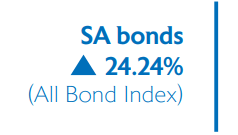
The JSE All Bond Index gained an impressive 24.2% in 2025. The bond rally has been supported by the SARB cutting the benchmark repo rate by 1% last year. This after inflation eased to a five-year low and geopolitical noise seems to have quietened down for now. The 10-year government bond yield fell below 9% for the first time in more than seven years.

Money market assets gained a respectable 7.5%.

Conclusion

As investors look to maintain robust and resilient portfolios in 2026, the call for maintaining broad diversification remains a key theme. For local investors, last year once again proved the importance of portfolio diversification and ongoing patience — equity markets rewarded investors who remained disciplined. Over the past decade, the JSE’s performance has been lacklustre compared to international markets. However, last year the local market surprised many investors with spectacular returns and outpaced developed markets in local currency — the rand strengthened 12% against the dollar last year. Hence, do not ‘write off’ the local market, our local equity and bond markets remain an important part of a welldiversified global portfolio.

Lastly, icon Warren Buffett (95) officially stepped down as the CEO of Berkshire Hathaway at the end of the year, after a remarkable 60-year tenure. The news of his official departure has been described as the “end of an era” in the business and investing world. As we enter 2026, it may be well thought-of to leave you with one of his many insightful lines in achieving long-term financial success.

Albert Louw
STANLIB Multi-Manager

More insights